
The Future of Outpatient Surgery: Connected Technology and Practical AI for the Modern ASC
Outpatient surgery has changed. The systems that support it need to catch up.
Advances in surgical technique, anesthetic practice, and medical devices have moved a growing range of procedures out of the inpatient setting and into ambulatory surgery centers (ASCs), where patients receive specialized care in efficient, cost-conscious environments.
The digital infrastructure behind perioperative care has not always kept pace. Preoperative information is often spread across several systems. In some facilities, intraoperative vital signs are still transcribed by hand. Assessments are re-entered at multiple points in the patient’s day, and administrators wait on manually assembled reports to understand how their operating rooms are performing. At the same time, artificial intelligence is beginning to change how healthcare organizations manage information and administrative work.
The goal is no longer simply to replace paper with electronic records. It is to build a perioperative environment in which information follows the patient from preoperative evaluation through recovery, and in which technology reduces clinical workload rather than adding to it. That is the premise behind IshaniPulse.
The Problem: One Episode of Care, Many Disconnected Systems
Consider a typical ASC with two or three operating rooms. On the day of surgery, registration confirms the patient’s information, preoperative nursing completes the assessment, the anesthesia provider reviews the history and finalizes the anesthetic plan, and the surgeon prepares for the case. Intraoperatively, physiologic monitors display continuous data while the anesthesia provider titrates medications, manages the airway, and documents events as they occur. In the post-anesthesia care unit (PACU), nursing continues monitoring and prepares the patient for discharge.
Clinically, this is one continuous episode of care. Technologically, it often is not. Scheduling, clinical documentation, the anesthesia record, billing, and reporting may each reside in a separate system, with paper forms, spreadsheets, and verbal handoffs bridging the gaps. Five problems follow:
- Documentation competes with patient care. Clinicians record medications, interventions, and patient responses while delivering care, and every redundant entry takes attention away from the patient.
- Monitors and the anesthesia record do not communicate. Without device integration, providers chart blood pressure, heart rate, oxygen saturation, and other parameters manually at set intervals, creating opportunities for transcription error and gaps in the record.
- Clinical information is fragmented. Preoperative assessments, schedules, intraoperative records, and postoperative documentation often live in separate applications, so clinicians must search for information that should already be in front of them.
- Operational visibility is limited. OR utilization, case delays, patient throughput, and documentation completeness are difficult to measure when the underlying data is scattered.
- Enterprise systems are built for hospitals. Many platforms assume hospital-scale IT resources. Independent ASCs need modern capabilities without that overhead.
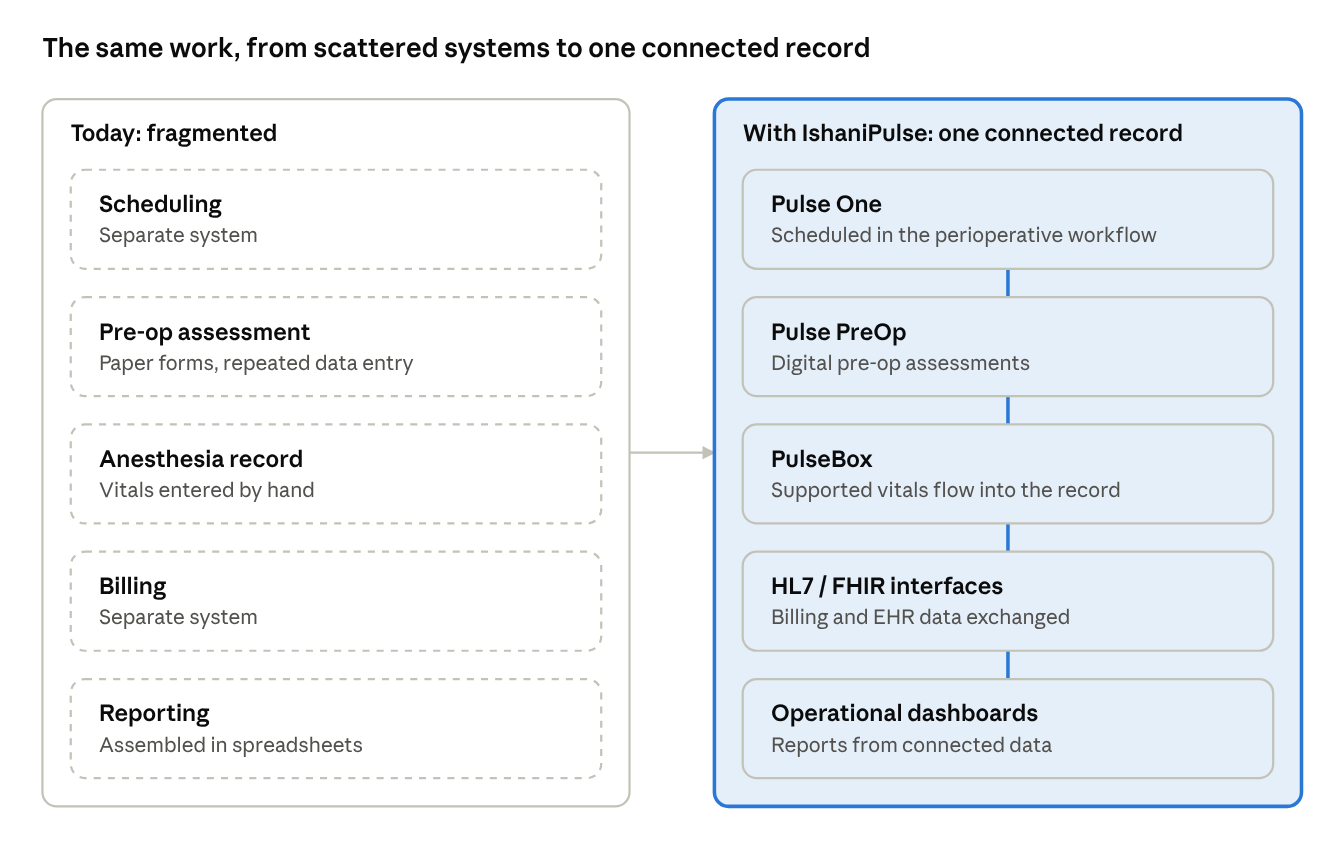
These problems are interconnected, and addressing them requires more than another standalone application.
Introducing IshaniPulse: A Connected Perioperative Platform
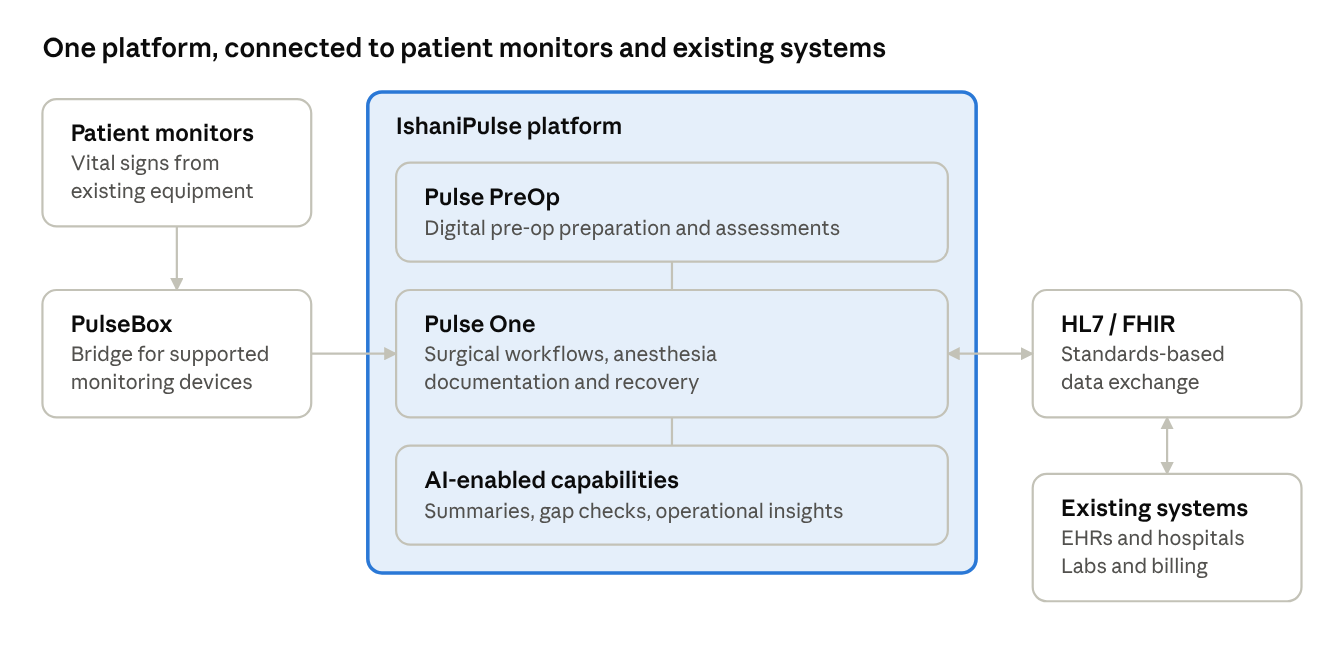
IshaniPulse is developing an AI-enabled perioperative platform designed specifically for ambulatory surgery centers. Its purpose is to connect the people, processes, devices, and information involved in each surgical case.
- Pulse One: surgical workflow, anesthesia documentation, and recovery in a single connected record.
- Pulse PreOp: digital preoperative preparation, assessment, and documentation.
- PulseBox: medical-device connectivity that brings data from compatible physiologic monitors into the digital record.
- AI-enabled capabilities: assistance designed to reduce repetitive work, make information easier to find, and support operational decisions.
- HL7 and FHIR interoperability: standards-based integration with the EHRs and information systems an ASC already uses.
PulseBox: Bringing Monitor Data Into the Anesthesia Record
Continuous physiologic monitoring is central to anesthesia care. Heart rate, blood pressure, oxygen saturation, and other parameters are core elements of the intraoperative record, yet what appears on the monitor does not automatically reach the electronic record.
Consider a 90-minute case. The anesthesia provider is managing the airway, titrating medications, responding to changes in the patient’s condition, and maintaining the record at the same time. Without integration, vital signs must be entered manually throughout the case. The monitor already holds the data, and the record needs it. There is little reason for the clinician to serve as the interface between the two.
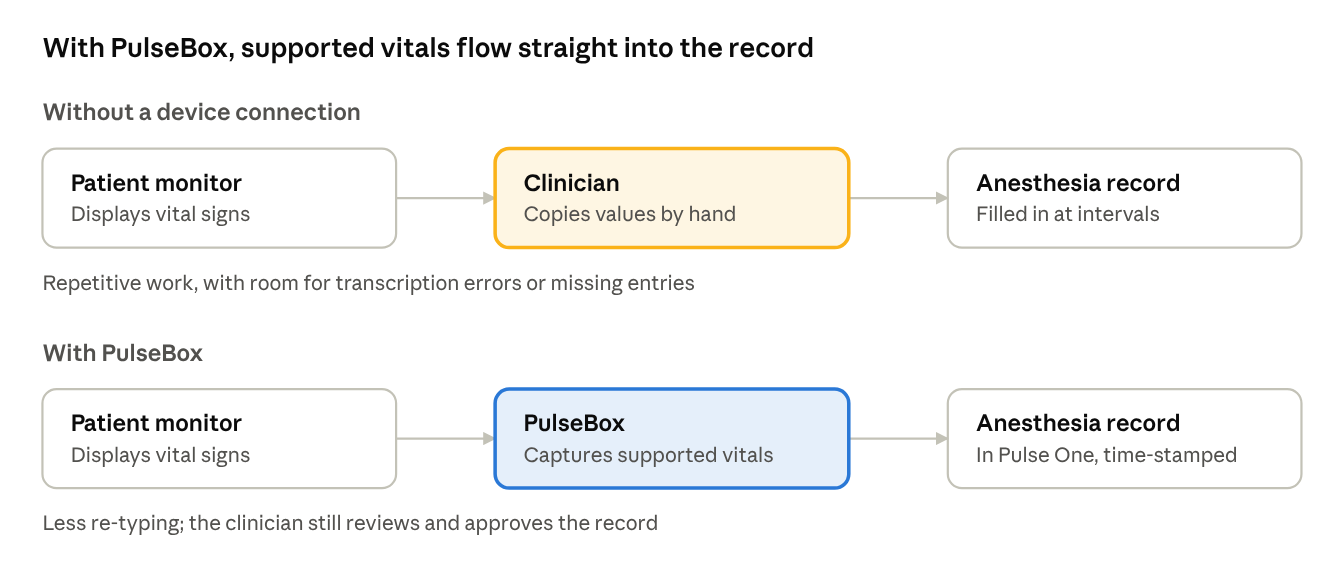
PulseBox is being developed as a connectivity bridge between compatible monitoring equipment and the IshaniPulse platform. It is intended to capture supported, time-stamped data and place it directly into the anesthesia documentation workflow, with the potential to:
- Reduce manual transcription of supported vital signs.
- Produce a more continuous and consistent intraoperative record.
- Place physiologic data alongside medications, fluids, and airway events in one documentation environment.
- Make monitoring data available to authorized members of the care team.
Why a hardware component? ASCs operate monitors from different manufacturers, with varying communication protocols and connectivity options. Some support direct software integration; others require an intermediary. Replacing functioning monitors solely to enable electronic documentation can be impractical and costly. PulseBox is intended to provide an integration pathway for supported devices, extending the usefulness of existing equipment rather than replacing it. Connectivity will depend on device compatibility, supported interfaces, validation, and deployment requirements.
AI in Perioperative Care: Assistive, Not Autonomous
The value of AI in a clinical setting depends on whether it solves a real problem. For ASCs, the most meaningful near-term opportunity is not autonomous clinical decision-making. It is reducing administrative burden, organizing information, and helping teams work more efficiently. IshaniPulse approaches AI as an assistive layer within existing perioperative workflows:
- Preoperative preparation. The preoperative review draws on medical and surgical history, medication lists, allergies, and prior procedures, often from several sources. AI could organize this information into a structured summary and flag incomplete assessment fields before the day of surgery. The determination of readiness for surgery and anesthesia remains a clinical judgment.
- Documentation support. AI could highlight gaps in the anesthesia record and organize documented events into a clear timeline for review. The clinician remains responsible for reviewing, correcting, and approving the record.
- Operational intelligence. Authorized users could query operational data in plain language, for example “Which operating room had the most delays this month?” or “What are the most common causes of late case starts?”
- Workflow coordination. Incomplete documentation and outstanding requirements could be surfaced automatically, helping staff prioritize without relying on manual tracking.
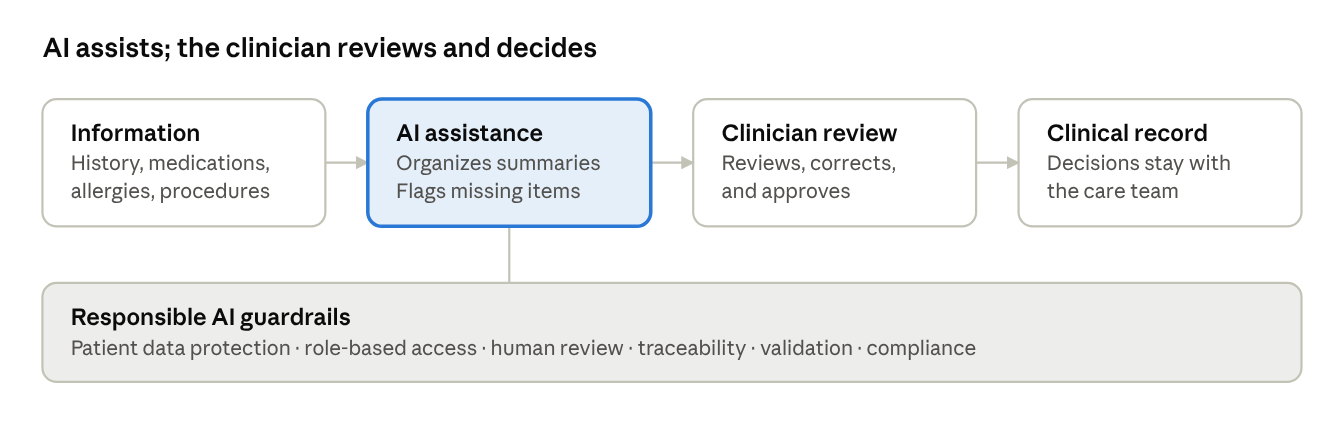
Responsible implementation. AI in clinical environments demands discipline. Any AI capability in IshaniPulse should protect patient information, enforce role-based access, require human review of clinically significant outputs, remain traceable and auditable, be validated for its intended use, and comply with applicable privacy, security, and medical-device requirements. The aim is not to replace clinical judgment, but to give clinicians better tools.
Interoperability: Why HL7 and FHIR Matter
No perioperative platform can function in isolation. ASCs exchange information with referring hospitals, EHRs, laboratories, and billing platforms. When those systems cannot communicate, staff re-enter data and reconcile records by hand, which is inefficient and introduces further opportunities for error.
HL7 messaging and HL7 FHIR are established standards for exchanging patient demographics, encounters, and clinical information. With standards-based integration, an ASC can receive supported patient information from a referring hospital or connected EHR rather than re-keying it, and can make relevant documentation available to authorized downstream systems after the procedure. The benefits are practical:
- Less duplicate entry, because information already held in connected systems can be reused.
- Better continuity across the preoperative, intraoperative, and postoperative phases.
- Incremental adoption, connecting existing systems instead of replacing every application at once.
- Stronger downstream workflows for reporting, billing interfaces, and operations.
Interoperability is also a prerequisite for useful AI, which can only be as good as the information available to it. Interoperability connects the information; AI helps turn it into insight.
How It Comes Together Across the Perioperative Continuum
Before surgery, the patient is scheduled through the perioperative workflow, supported integrations bring in relevant information from connected systems, and Pulse PreOp supports the digital assessment, with AI flagging incomplete items for staff review. Intraoperatively, the anesthesia provider documents medications, fluids, airway management, and clinical events in Pulse One while PulseBox supplies supported vital signs from compatible monitors, and the clinician retains oversight of the record. In the PACU, recovery staff work from the same perioperative record; the team completes and reviews documentation, and supported integrations share authorized information downstream.
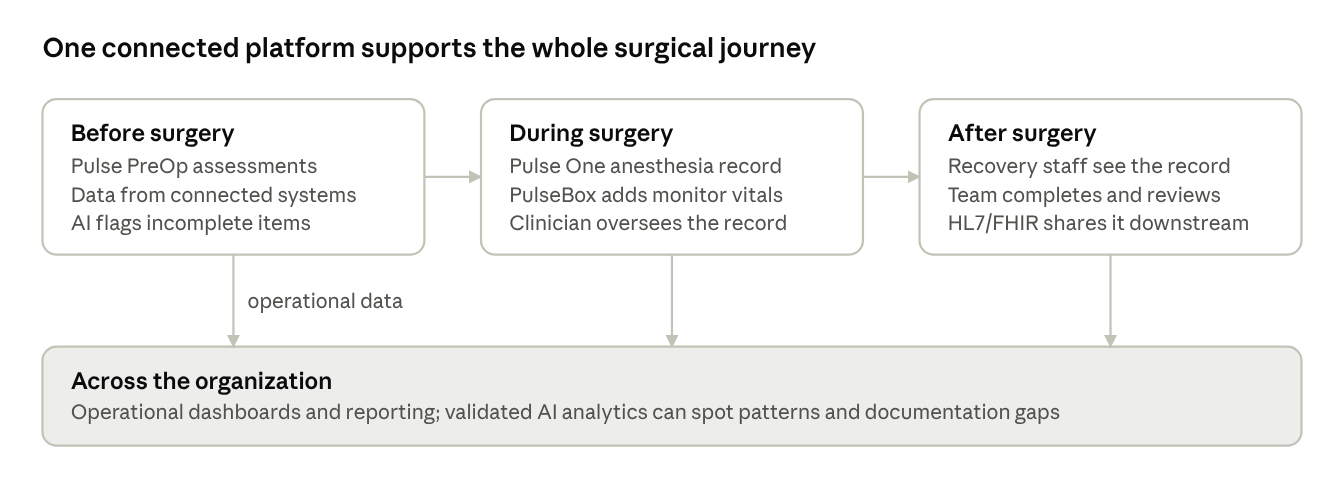
At the organizational level, administrators gain operational dashboards and reporting. As AI capabilities mature and are validated, analytics could help identify workflow patterns, documentation gaps, and opportunities for improvement. The result is technology that supports the entire surgical episode rather than isolated tasks.
Built for Independent ASCs
Independent and smaller ASCs balance clinical quality, staffing, scheduling, documentation, and financial performance without the IT departments of large health systems. For these centers, implementation complexity, training time, integration cost, and ongoing maintenance are decisive. IshaniPulse is being designed around those constraints, with an emphasis on connected workflows, practical device integration, interoperability, and AI directed at well-defined problems.
The company grew out of a straightforward observation: healthcare technology has advanced dramatically, yet much of the perioperative workflow remains unnecessarily disconnected. The founding team combines firsthand anesthesia care experience with expertise in healthcare software engineering, cloud infrastructure, data integration, and digital health. The intent is a platform in which documentation, monitoring data, preoperative preparation, and operations are connected, and in which interoperability is designed in from the start rather than added later.
The Future Is Connected, Intelligent, and Clinician-Centered
Perioperative technology should be judged not by the length of its feature list but by how well it supports the people delivering care. Does it reduce redundant documentation? Does it connect information that already exists? Does it give administrators a clear view of their operations? Does it support clinicians without adding complexity? Does it work with the devices and systems already in place? These questions guide our work.
We believe the future of perioperative technology lies at the intersection of connected clinical workflows, interoperable devices and information systems, and responsible, practical AI. Outpatient surgery deserves more than digital records. It deserves connected intelligence.
About IshaniPulse: IshaniPulse is a healthcare technology company developing an AI-enabled, interoperable perioperative platform for ambulatory surgery centers. Its solutions include Pulse One for connected perioperative workflows, Pulse PreOp for preoperative preparation, and PulseBox for medical-device connectivity.
Join the discussion
React with an emoji, or subscribe to IshaniPulse Insights to comment. Sign in with your Google account to take part.